Jefferson Flanders

The website of author Jefferson Flanders

Seven Questions for the Author of North to Nantucket

Here are seven questions for Jefferson Flanders, author of North to Nantucket.
Q: What inspired you to write about the Civil War?

A: As I’ve noted before, it was a combination of a lifelong interest in the conflict, sparked by a visit to Gettysburg as a boy with my father, and encountering the 73 names on Nantucket’s Civil War memorial and wondering about their stories.

As I began my research, I learned that most Nantucket men had served in the  20th Massachusetts Volunteer Infantry Regiment, which was dubbed the “Bloody 20th” (and, later, the “Harvard Regiment” for the large number of Harvard graduates in its ranks).

It seemed fitting to have Gabriel North, a Harvard graduate, join the 20th Regiment along with his brother Michael and experience the difficult early years of the war.

I was fortunate to have two deeply researched historical accounts to turn to: Harvard’s Civil War: The History of the Twentieth Massachusetts Volunteer Infantry by Richard F. Miller and The Civil War: The Nantucket Experience by Miller and Robert E. Mooney.

Q: Nantucket sits at the center of the story…

A: Yes, it does. I’ve sought to show how the Civil War profoundly shaped the lives of islanders. We see the impact at home through the eyes of Charlotte Hathaway. Nantucket became an island of women during the war. It wasn’t the first time that this had happened, for during the whaling years, many of Nantucket’s men were away on voyages of three years, but the consequences of the war were more severe.

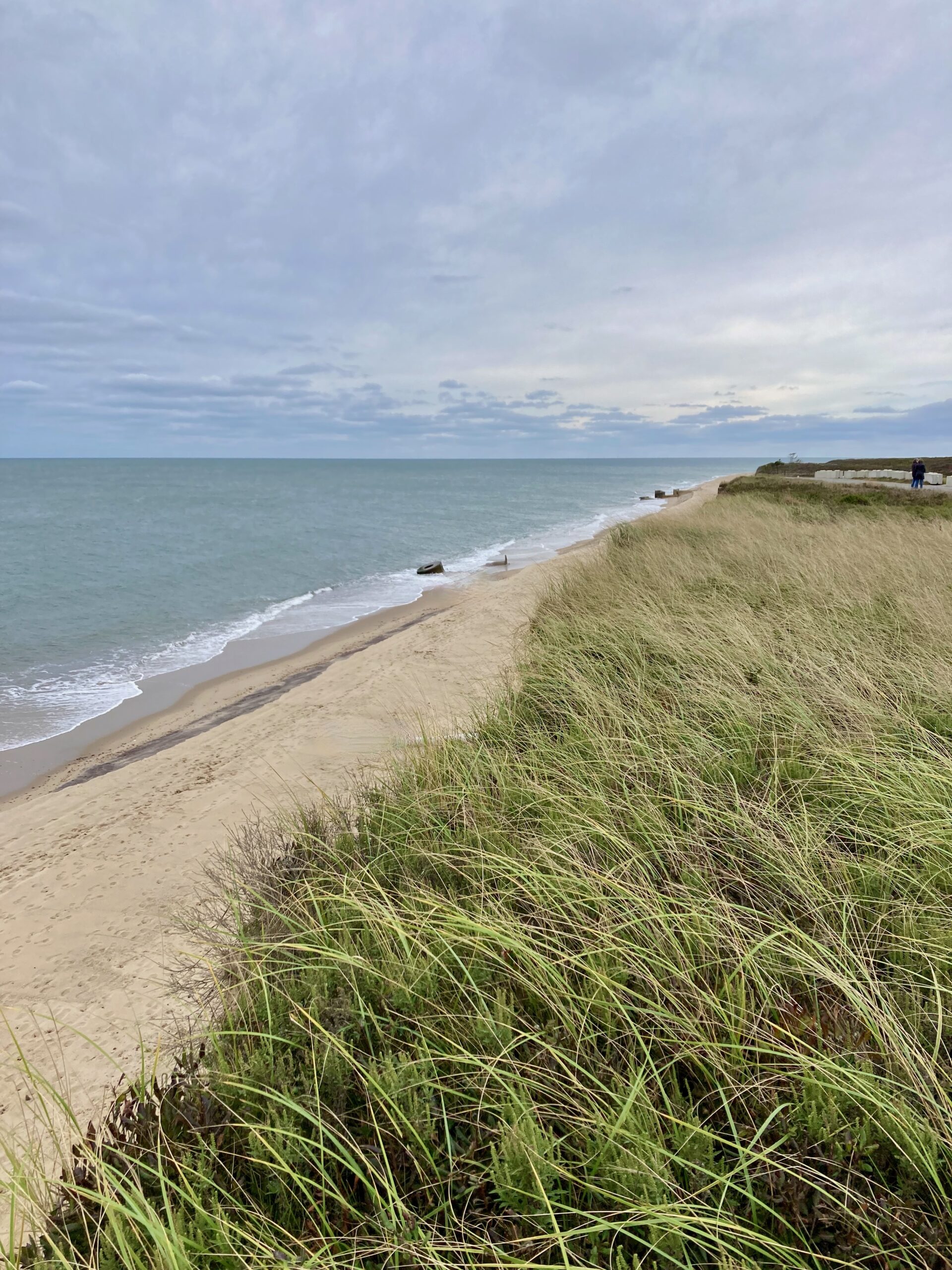
Nantucket wasn’t the summer playground of the wealthy then, as it is today. I tried to capture the insularity of island life, the isolation from the mainland, but also the strong sense of community and the amazing physical beauty of the place. (It’s easier today to explore the out-of-the-way spots in a Jeep with four-wheel drive!). In some ways, Nantucket hasn’t changed, and it’s no wonder that it engenders a deep loyalty.

Q: In researching the novel, what surprised you?

A: I hadn’t realized how unpopular the war was in certain Northern quarters. While Boston remained a center of abolitionism, there were also a fair number of Copperheads. The 20th Regiment also bore the nickname “The Copperhead Regiment” because many of the Harvard officers were sympathetic to the South and argued that they had volunteered to restore the Union, not abolish slavery. It was a shock to learn that Oliver Wendell Holmes, Jr., future Supreme Court justice, was among the dissenters. And there was considerable working-class opposition to the war from the Irish in Boston and New York, which surfaced in draft riots.

At the same time, I must note the willingness of thousands of young men who  were willing to fight and die for the Union and to abolish slavery.

One other discovery: I hadn’t realized that in the summer of 1864, as the Union war effort stalled, President Lincoln thought he was going to lose the election to McClellan and the Peace Democrats. The victories of Sherman in Georgia and Sheridan in the Shenandoah Valley convinced voters to stay the course, that victory over the South was possible.

Q: This is your 12th novel…

I have been accused of being prolific. But I like telling stories and, as far as I can tell, my books have been well-received.

I don’t suffer from writer’s block. My time at the Associated Press and as a sportswriter, meeting deadlines, helped cure me of any perfectionism. I’ve learned that “steady does it,” that sticking to a daily writing routine pays off, as does the confidence that you can find a way out of any plot corner that you write yourself into.

I’d like to think that over time  I’ve gotten better at my craft, but that may be wishful thinking. A friend who has read all my novels tells me his favorite is Herald Square, my first foray into fiction.

Q: Do you have a favorite?

No, actually, I don’t. I do have favorite characters. Karina Lazda (Herald Square), Feliks Hawes (The Hill of Three Borders, Charles Bridge), Dillon Randolph and Christa Schiller (An Interlude in Berlin). It typically takes me a year to finish a novel, which means I spend a year with the characters, imagining their story. It’s hard at the end to let them go.

Q: What’s next?

I’ve started the research and writing process for my latest project, a sequel to North to Nantucket. I found there were more stories to tell. This next novel will follow the lives of several Philadelphians, including Dr. Conor Fitzpatrick, who appears in North to Nantucket. At my current pace, publication will be in the Spring of 2027.

_______________________________

Copyright © 2026 Jefferson Flanders
All rights reserved
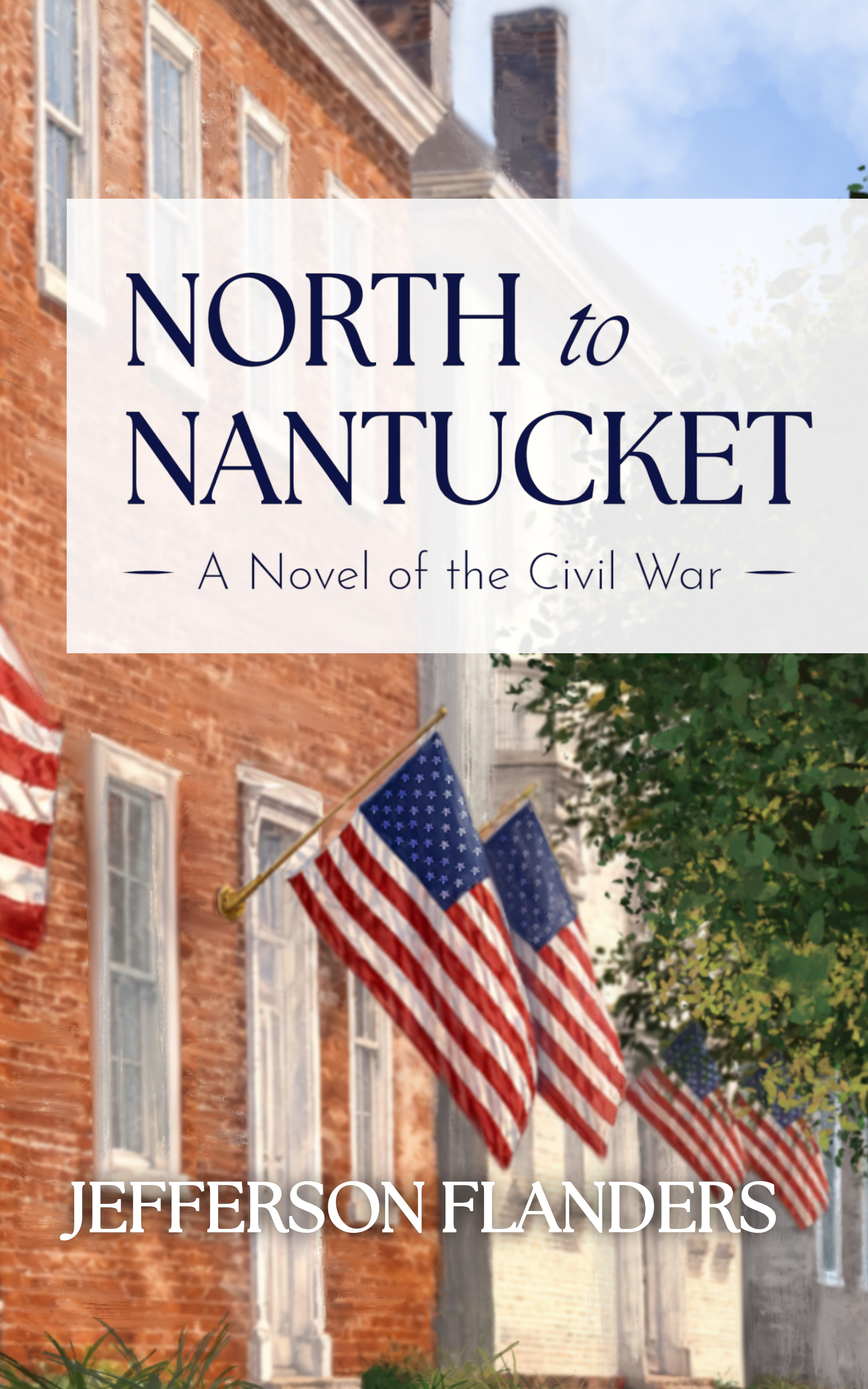
North to Nantucket: A novel of the Civil War

In his twelfth novel, author Jefferson Flanders tells the intertwined story of Nantucket islanders Gabriel North and Charlotte Hathaway during the Civil War, a story of faith, love, and sacrifice in extraordinary times. 

From windswept island beaches to fiercely contested battlefields, North to Nantucket immerses readers in the heartbreak and courage of a tragic conflict whose unresolved questions still challenge Americans today.

AUTHOR’S NOTE:

My lifelong interest in the Civil War began with a visit to Gettysburg as a boy. Years later, when I found Nantucket’s monument to the 73 men who died in the conflict—a striking number for such a small community—I was prompted to learn more. What I discovered in researching the resilience of island life during the war inspired me when I imagined Gabriel and Charlotte’s story.

NOW AVAILABLE:

Paperback | Kindle

Cover design and illustration by Taylor Coughlin

© 2026 Jefferson Flanders

Artificial fiction?

Who can dispute that fiction is a form of artifice? The novelist or short story author creates an artificial world, one that seeks to imitate reality. One of the definitions of “artificial” is that it’s a man-made copy of something natural. With the rise of Artificial Intelligence (AI), that definition will need to recognize copies–imitations– made by machine. (More on that, and the implications for fiction-writing, in a moment).

I suspect literary imitation has been around as long as storytelling. Oscar Wilde argued that imitation was mediocrity’s concession to greatness, but that’s too harsh. Is any work of art completely original?

It had been several years since I had read H.E. Bates’ 1944 novel Fair Stood the Wind For France. Bates tells the story of a Wellington bomber pilot in World War II who, once downed over France, must overcome significant challenges in evading German pursuit. The pilot, John Franklin, falls in love with a young Frenchwoman and she helps him escape. What struck me in re-reading the novel was its obvious creative debt to Ernest Hemingway’s For Whom the Bell Tolls, which was published in 1940.

The similarities are obvious. Bates employs the same flat prose style of Hemingway with its echoes of the King James Version of the Bible. There’s the plot driven by the dangers of operating behind enemy lines. And there’s the romance between the male protagonist and a clever country girl. Imitation is said to be the sincerest form of flattery, and Bates was (consciously or unconsciously) paying homage to Papa Hemingway. Yet, contra Wilde, the novel is not mediocre.

Judged on its own merits, Fair Stood the Wind For France is an entertaining, if somewhat circumscribed, novel that sacrifices emotional depth for narrative intensity. To his credit, Bates stops short of “full Hemingway,” and so we’re spared the awkward repetitious meanderings of For Whom the Bell Tolls. (For what it’s worth, I’d argue that A Farewell to Arms is Hemingway’s greatest work). Yet to give credit where credit is due, despite some derivative elements Fair Stood the Wind For France can lay claim to its own authenticity: Bates had been commissioned into the Royal Air Force to write stories dramatizing aerial warfare, and he could draw on the experiences of the pilots and air crews flying into combat.

Questions about imitation and authenticity will abound in the Age of AI. Already Amazon is working to choke off so-called AI “scam books,” which include AI-generated biographies, summaries of popular books, and copycat books. Jane Friedman, a writer and publishing industry analyst, interviewed by NPR last year argued the current crop of AI-books had a inhumane, generic quality: “It just feels like a human didn’t write these. Humans would — funnily enough — do a better job being bad.”

But it’s clear it’s only a matter of time before generative AI is employed to create works that pass the literary equivalent of the Turing test. Nonfiction shouldn’t pose much difficulty for large language model (LLM) AI, assuming an ample underlying database with vetted content and some level of human review to spot and eliminate hallucinations and other ghosts in the machine.

Fiction presents more challenges. Screenplays–which are largely made up of dialog and typically have simple plots–are a logical initial AI target. There are clear patterns and archetypes for AI to mimic– the three act structure, and the twelve steps of the Hero’s Journey. Netflix and Amazon have collected vast amounts of viewer data which they feed to AI to help fashion more compelling scenes.

Novels are more complex, but their narrative structure can be copied. Some genres will lend themselves to AI imitation. And certainly AI can copy the distinctive style of a Hemingway (or Jane Austen or Cormac McCarthy) and generate prose that mimics the original.

Could AI produce a novel that mimics Fair Stood the Wind For France in the way Bates borrowed from Hemingway? Could it generate a tense World War II story set behind enemy lines with a young hero helped/saved by a courageous and appealing farm girl? For now, I think the AI engine would still need someone (a human) providing extensive prompts to create a seamlessly executed novel. (Note bene: I won’t be the one experimenting. I’ve kept my distance from AI on both practical and principled grounds). Tomorrow? AI writing fiction autonomously? Who doubts that it is technically possible? Considering recent claims that AI may be learning to shake off human control (the SkyNet threat), we may not have much of a say in the matter.

© 2025 Jefferson Flanders

Where the stories come from

So where do the stories come from?

Are they drawn from a Jungian collective unconscious? Stories from our primal past, of hunting and being hunted, of rivalries within the tribe and without. Stories with a structure, the Hero’s Journey, the monomyth.

The emotional foundation underlying these stories aren’t uniquely human. Take anger or jealousy. If you watch video of an experiment with capuchin monkeys (conducted by the late primatologist Dutch Frans de Waal) you’ll discover that our primate relative are capable of rage and envy if they think they’re being treated unfairly.

So there’s a deep evolutionary reservoir for anyone creating to draw upon. And a psychological one. Although Dr. Freud has fallen out of favor, his insights into human behavior are, in essence, a form of storytelling. (Freud admired William Shakespeare and the Bard had a significant influence on the development of psychoanalytic theory.)

Then, there’s the body of literature waiting to be strip-mined for plots and characters. Writers are literary magpies, always ready to create derivatives. Sometimes their borrowing is overt, sometimes not so (thus, plagiarism scandals).

At a more subconscious level, there’s the impact on an author of every word they’ve ever read. The choice of words, the cadence, the propensity for plain prose or something more Rococo, are influenced by what the mind takes in.

Finally, there’s the creator’s imagination. The story emerges, imagined, through a smelting process that refines these remembered elements into something recognizable, something that appeals to us, that makes us want to learn more, to read on, to turn the page.

© 2025 Jefferson Flanders

Writing what you don’t know

C.S. Lewis,, the English academic , author, and Christian apologist, once offered this advice on writing: “Write about what really interests you, whether it is real things or imaginary things, or nothing else.”

I think that’s much better advice than the “write what you know” cliché that many writing instructors typically suggest for beginners. Yes, I get that recommendation is meant to encourage creative authenticity, but it ignores the more important factor of creative enthusiasm.

It typically takes me more than a year to complete a novel, from start to finish. I can’t imagine investing that time and effort without deeply engaging with the story. Why would I write about something that doesn’t move me?

For the most part, prior knowledge is overrated when writing fiction. If you’re caught up in creating a compelling narrative, you can learn what you need to know–and rely on your imagination to fill in any blanks. I’ve written before about how with enough craft and some diligent research, some well-regarded novelists have fashioned a seamless fictional world with little or no first-hand experience:

Experts on life in the Soviet Union raved about the accuracy of Martin Cruz Smith’s Gorky Park, and yet the novelist didn’t speak Russian and spent only two weeks in Moscow before writing his bestseller. Patrick O’Brian, author of the famous maritime series featuring Jack Aubrey, apparently couldn’t sail. Sid Smith’s Something Like a House, a novel about the Cultural Revolution, won Britain’s Whitbread First Novel Award and yet Smith couldn’t read or speak Chinese, and hadn’t worked in or visited China. Creativity, it seems, can trump biography. In fiction, what matters is that the reader believes.

Of course, it is possible to write largely out of one’s experience, and that’s a valuable foundation for any writer. Yet writing what you don’t know but are keenly interested in strikes me as a more creatively rewarding path to follow.

© 2025 Jefferson Flanders

« Older posts

© 2026 Jefferson Flanders

Theme by Anders NorenUp ↑